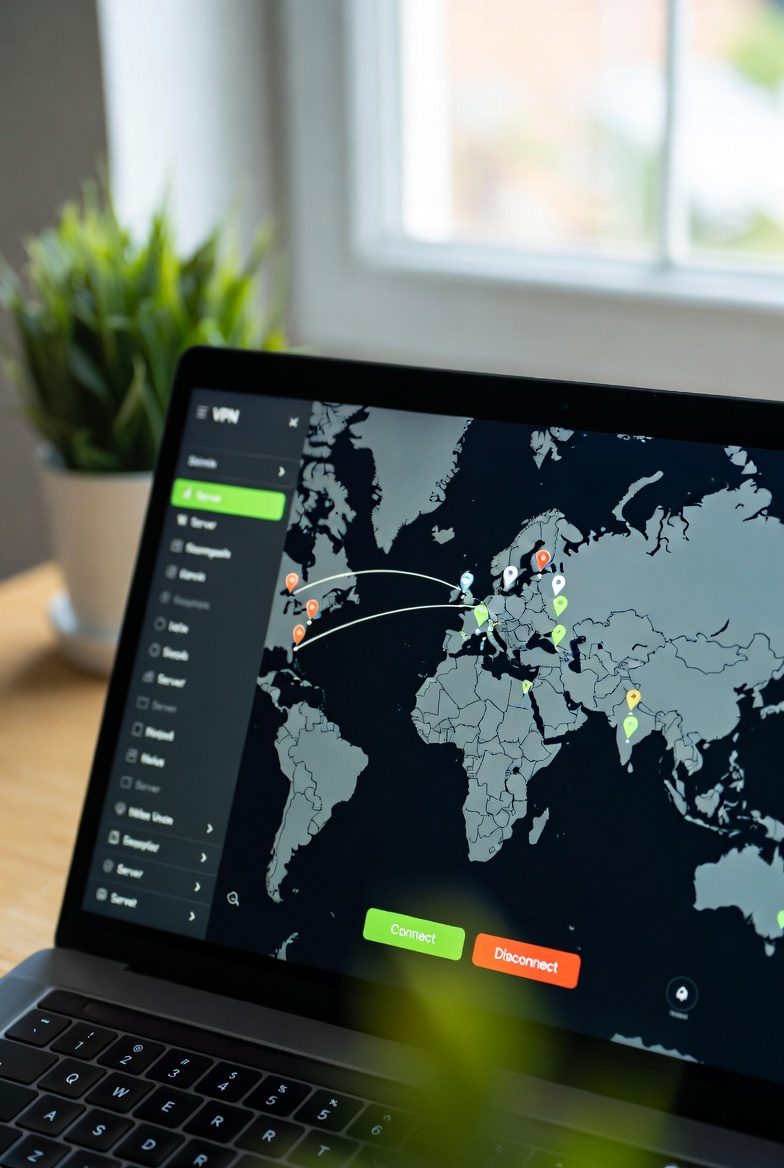
VPN — What Does It Actually Do?
VPN stands for Virtual Private Network. It does two things simultaneously: encrypts your internet traffic and hides your real IP address by routing your connection through a server in another location.
Think of it like sending a letter. Without a VPN — your internet provider sees the recipient, the content, and your return address. With a VPN — your provider only sees that you sent an encrypted package to one location. What's in that package and where it goes next — they can't see.
| Situation | Without VPN | With VPN |
|---|---|---|
| Home Wi-Fi | ISP sees every website you visit | ISP sees only encrypted connection |
| Public Wi-Fi (café, hotel) | Network admin can intercept data | All traffic encrypted — safe |
| Websites see your location | Real location visible | VPN server location shown instead |
| IP-based tracking | Advertisers can track you by IP | Real IP hidden behind VPN IP |
| Netflix abroad | Geo-blocked content unavailable | Connect to server in target country |
| ISP throttling | ISP can slow streaming/torrents | ISP cannot see what you're doing |
VPN Encryption — How It Works
When you connect to a VPN, your device creates an encrypted tunnel to the VPN server. All your internet traffic travels through this tunnel — your ISP only sees encrypted data going to the VPN server, nothing else.
Modern VPNs use AES-256-GCM encryption — the same standard used by banks, governments and the military. Breaking AES-256 by brute force would take longer than the age of the universe, even with every computer on Earth working together.
| Protocol | Speed | Security | Best For |
|---|---|---|---|
| WireGuard / NordLynx | ⚡ Fastest | Excellent | Everyday use, streaming, gaming |
| Lightway 2.0 (ExpressVPN) | Very fast | Excellent + post-quantum | Streaming, censorship bypass |
| OpenVPN TCP/UDP | Medium | Proven (20+ years) | High security, obfuscation |
| IKEv2/IPSec | Fast | Good | Mobile — handles network switching |
Do You Need a VPN?
Yes, you probably do — if any of these apply:
- You use public Wi-Fi (airports, cafés, hotels): Open networks are easy to intercept. A VPN encrypts everything regardless of the network's security.
- You want streaming from other countries: Netflix USA has ~3,000 more titles than Netflix Poland. NordVPN unlocks 15+ libraries, ExpressVPN unlocks 20+.
- You care about ISP privacy: Your internet provider legally can — and in some countries must — record your browsing history. A VPN prevents this.
- You torrent: VPN hides your IP from BitTorrent swarms and copyright trolls. Only use VPNs with audited no-logs policies (NordVPN: 5× audited).
- You travel to censored countries: China, Russia, UAE block major websites and apps. A VPN with obfuscation (ExpressVPN Lightway, NordVPN Obfuscated) bypasses the Great Firewall.
You probably don't need a VPN if: you only ever use your own secured home network, you're not concerned about ISP data collection, and you don't travel internationally.
Which VPN Should Beginners Choose?
| Goal | Recommended VPN | Why | Price |
|---|---|---|---|
| 🏆 Best overall | NordVPN | Fastest (953 Mbps), 5× audited, post-quantum | $3.39/mo |
| 💰 Cheapest | Surfshark | $1.99/mo, unlimited devices, 7-day free trial | $1.99/mo |
| 🎬 Best for Netflix | ExpressVPN | 20+ Netflix libraries, most reliable unblocking | $2.79/mo |
| 🔒 Most private | ProtonVPN | 100% open-source, Switzerland, free plan | $2.99/mo |
| 🛡 Easiest to use | CyberGhost | Servers labeled per streaming service, 45-day guarantee | $2.19/mo |
VPN Myths — Debunked
A VPN is an app that encrypts your internet connection and hides your real IP address. Your internet provider sees only that you're connected to a VPN server — not which websites you visit or what you download.
Yes — in most countries including the entire EU, USA, UK, Canada and Australia. VPNs are restricted (not banned) in Russia and UAE. See our full VPN legality guide →
A good VPN on a nearby server loses only 5–15% speed. NordVPN retains 95.3% of a 1 Gbps line in our tests. On a standard 100 Mbps home connection you won't notice any difference.
A VPN routes your traffic through one server — fast, suitable for streaming and everyday use. Tor routes through 3+ random servers — very slow but more anonymous. For most people, a VPN is the right choice.
Your ISP can see you're connected to a VPN server but not what you're doing through it. With obfuscated servers (NordVPN, ExpressVPN) even this is hidden — traffic looks like regular HTTPS.